Some videos on this page are currently unavailable due to a sudden interruption in service from our video technology provider. AnyClip. We are working to restore access and move the affected videos to a new solution as quickly as possible. Thank you for your patience. You can watch all content from this event on our Youtube channel.
National Emergency Briefing
The climate and nature crisis
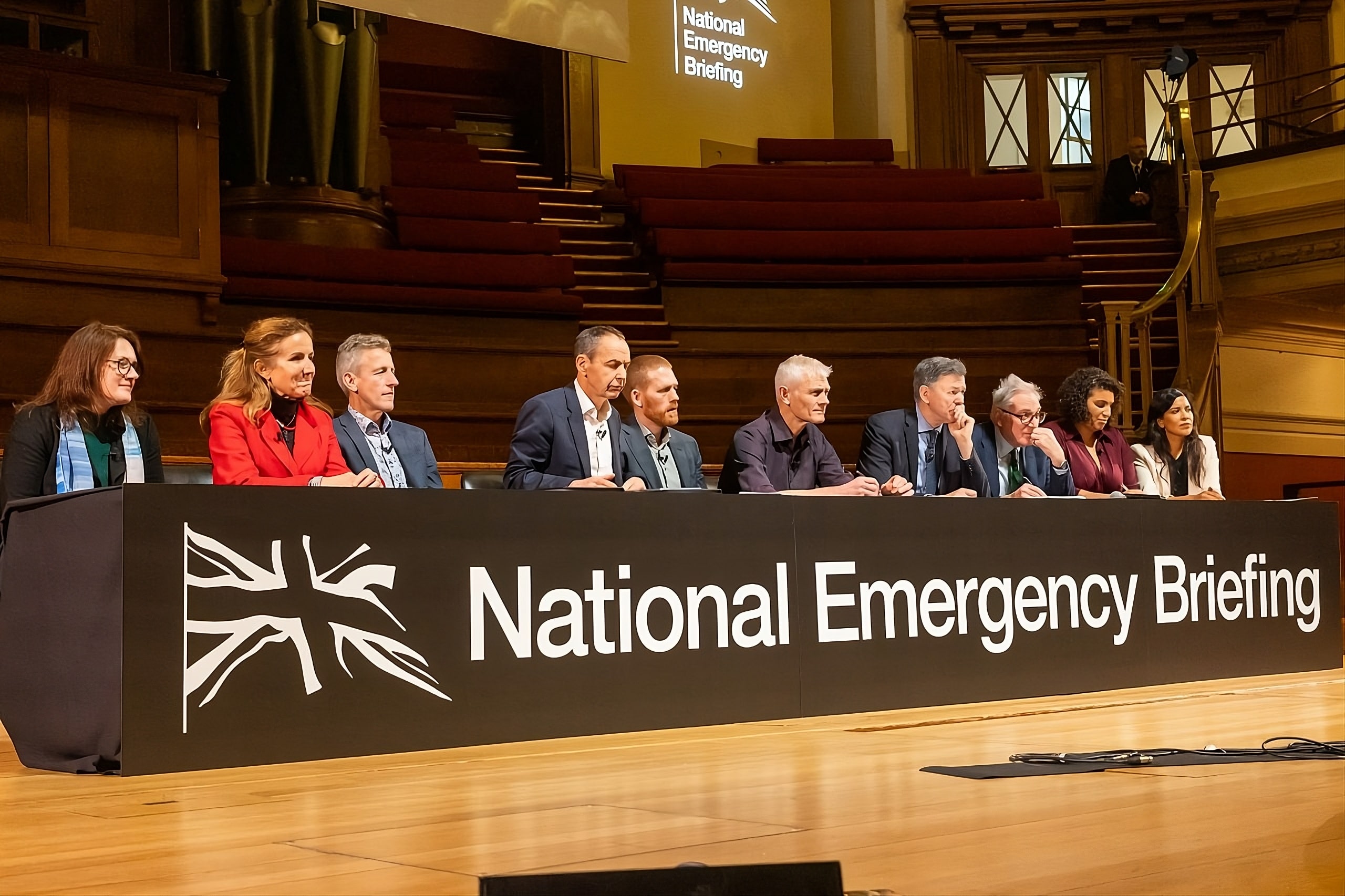
On 27 November, ten of the UK’s leading scientists and experts delivered a high-level National Emergency Briefing to an invitation-only audience of around 1,250 people — including politicians, business leaders, and representatives from culture, faith, sport and the media. The briefing presented the latest evidence on how the climate and nature crisis is already impacting health, food security, national security and the economy.
We Don’t Have Time was proud to partner as the official media outlet for this landmark event. We will continue releasing interviews, analysis and key moments from the briefing on this page.
The National Emergency Briefing is designed as an open-source model that people in any country will be able to adapt — enabling citizens to deliver clear, science-based briefings directly to their own parliaments and political leaders.
In the coming months, we will release guidance, templates and resources to help communities organise their own briefings around the world.
Sign up to receive updates, tools and the latest information on how to take part in this growing global initiative.
Professor at Lancaster University and one of the world’s leading experts on carbon footprints, supply-chain emissions and climate solutions. He is the founder of Small World Consulting, a pioneering organisation helping businesses and governments measure and reduce their climate impact. Berners-Lee is the author of several influential books, including How Bad Are Bananas?, There Is No Planet B, and The Carbon Footprint of Everything, which have become essential guides for understanding the climate crisis. Through his research, writing and public communication, he translates complex climate science into clear, actionable insights for policymakers, companies and the wider public. He advises organisations around the world and is widely recognised for making climate data accessible, scientifically grounded and impossible to ignore.
Kevin Anderson
(
UK
)
Professor
Kevin Anderson holds the Zennström professorship at Uppsala University and is chair of energy and climate change at the School of Mechanical, Aerospace and Civil Engineering (MACE) at the University of Manchester. He has been Deputy and Interim Director of the Tyndall Centre. He is a non-executive director of Greenstone Carbon Management. Kevin is research active with recent publications in Science, Nature and Nature Geosciences. Kevin engages widely across all tiers of government (UK and Sweden) on issues ranging from shale gas, aviation and shipping to the role of climate modelling (IAMs), carbon budgets and negative emission technologies. His analysis previously contributed to the framing of the UK’s Climate Change Act and the development of national carbon budgets. Kevin has a decade’s industrial experience, principally in the petrochemical industry. He is a chartered engineer and a fellow of the Institution of Mechanical Engineers.
Rachael Garrett
(
UK
)
Professor
Professor of Conservation and Development at the University of Cambridge and a Fellow of Homerton College. She leads the Conservation and Development Lab, where her work focuses on the drivers of land-use change, forest conservation, and sustainable agriculture across Latin America, West Africa, Southeast Asia and Europe. Her research examines how policies, supply chains and economic systems can be transformed to protect forests while improving livelihoods. She co-chairs the Global Land Programme Science Steering Committee and serves on UN science panels for the Amazon and for sustainability standards.
Professor Tim Lenton
(
)
Chair in Climate Change and Earth System Science, University of Exeter
Tim has more than 25 years research experience, focused on modelling of the biosphere, climate, biogeochemical cycles, and associated tipping points. Tim is renowned for his work identifying climate tipping points, which informed the setting of the 1.5C climate target, associated net zero targets, and nationally determined contributions. He works with policymakers and businesses helping them assess the risks of climate change and nature loss and highlighting the opportunities for ‘positive tipping points’ that can accelerate change towards net zero.
Hayley Fowler
(
UK
)
Professor
Professor of Climate Change Impacts at Newcastle University and one of the UK’s leading experts on extreme weather. Her research focuses on how climate change is driving increases in heatwaves, floods and storms, and what this means for communities, infrastructure and national resilience. She works closely with government agencies, scientists and planners to translate climate data into actionable strategies that protect people and systems in a rapidly warming world.
Hugh Montgomery
(
)
Professor of Intensive Care Medicine, University College London
Hugh Montgomery is Professor of Intensive Care Medicine. He co-chairs the 57-country Lancet Countdown on Health & Climate Change; & co-leads the UCL MSc module on climate & health; was appointed London Leader by Greater London Authority’s Sustainable Development Commission; has attended many of the international ‘COP’ negotiations; chairs the UK Health Alliance on Climate Change representing >1.1m healthcare professionals; ais medical lead for the UK National Emergency Brief; & was awarded the Order of the British Empire in 2022 for this work. In 2023, he founded non-profit Real Zero to leverage the global health economy as a tool to decarbonize society more generally.
Angela Francis
(
)
Chief Economics Advisor at WWF
Angela has always found ways to focus on how our human systems – energy, production, consumption, transport and planning – need to change to come into line with our planetary ones. After finding her home in the environmental advocacy sector 4-5 years ago, Angela is now Chief Advisor on Economics and Economic Development at WWF (World Wide Fund for Nature). She provides economic advice across the climate, food and nature programmes, as well as leading on trade and industrial policy for a green transition.
Paul Behrens
(
UK
)
Dr (Assistant Professor of Environmental Change), Leiden University
Paul Behrens is a British author and academic in environmental change at Leiden University. His popular science book, The Best of Times, The Worst of Times: Futures from the Frontiers of Climate Science (Indigo Press 2021) describes humanity’s current trajectory and possible futures in paired chapters of pessimism and hope, on topics including the economy, energy, land and population. He is editor and author of Food and Sustainability (Oxford University Press, 2019). His research on food and energy systems, land use and climate change has appeared in scientific journals and media outlets such as The New York Times, Scientific American, Nature Sustainability, Nature Energy, Nature Communications, PNAS and the BBC.
Richard Nugee
(
UK
)
Former Chief of Defence People, UK Ministry of Defence
A former senior British Army officer and one of the UK’s leading voices on climate and national security. After serving as Chief of Defence People at the Ministry of Defence, he led the landmark UK Defence Climate Change and Sustainability Review, which set the long-term strategy for preparing the Armed Forces for a warming world. He now works as an independent adviser helping governments, defence organisations and businesses understand how climate change affects security, infrastructure resilience and geopolitical stability. His work focuses on integrating climate risk into national security planning, ensuring that military and civil institutions are prepared for the escalating impacts of extreme weather, resource pressures and global instability.
Professor at Lancaster University and one of the world’s leading experts on carbon footprints, supply-chain emissions and climate solutions. He is the founder of Small World Consulting, a pioneering organisation helping businesses and governments measure and reduce their climate impact. Berners-Lee is the author of several influential books, including How Bad Are Bananas?, There Is No Planet B, and The Carbon Footprint of Everything, which have become essential guides for understanding the climate crisis. Through his research, writing and public communication, he translates complex climate science into clear, actionable insights for policymakers, companies and the wider public. He advises organisations around the world and is widely recognised for making climate data accessible, scientifically grounded and impossible to ignore.
Kevin Anderson holds the Zennström professorship at Uppsala University and is chair of energy and climate change at the School of Mechanical, Aerospace and Civil Engineering (MACE) at the University of Manchester. He has been Deputy and Interim Director of the Tyndall Centre. He is a non-executive director of Greenstone Carbon Management. Kevin is research active with recent publications in Science, Nature and Nature Geosciences. Kevin engages widely across all tiers of government (UK and Sweden) on issues ranging from shale gas, aviation and shipping to the role of climate modelling (IAMs), carbon budgets and negative emission technologies. His analysis previously contributed to the framing of the UK’s Climate Change Act and the development of national carbon budgets. Kevin has a decade’s industrial experience, principally in the petrochemical industry. He is a chartered engineer and a fellow of the Institution of Mechanical Engineers.
Professor of Conservation and Development at the University of Cambridge and a Fellow of Homerton College. She leads the Conservation and Development Lab, where her work focuses on the drivers of land-use change, forest conservation, and sustainable agriculture across Latin America, West Africa, Southeast Asia and Europe. Her research examines how policies, supply chains and economic systems can be transformed to protect forests while improving livelihoods. She co-chairs the Global Land Programme Science Steering Committee and serves on UN science panels for the Amazon and for sustainability standards.
Chair in Climate Change and Earth System Science, University of Exeter
Tim has more than 25 years research experience, focused on modelling of the biosphere, climate, biogeochemical cycles, and associated tipping points. Tim is renowned for his work identifying climate tipping points, which informed the setting of the 1.5C climate target, associated net zero targets, and nationally determined contributions. He works with policymakers and businesses helping them assess the risks of climate change and nature loss and highlighting the opportunities for ‘positive tipping points’ that can accelerate change towards net zero.
Professor of Climate Change Impacts at Newcastle University and one of the UK’s leading experts on extreme weather. Her research focuses on how climate change is driving increases in heatwaves, floods and storms, and what this means for communities, infrastructure and national resilience. She works closely with government agencies, scientists and planners to translate climate data into actionable strategies that protect people and systems in a rapidly warming world.
Professor of Intensive Care Medicine, University College London
Hugh Montgomery is Professor of Intensive Care Medicine. He co-chairs the 57-country Lancet Countdown on Health & Climate Change; & co-leads the UCL MSc module on climate & health; was appointed London Leader by Greater London Authority’s Sustainable Development Commission; has attended many of the international ‘COP’ negotiations; chairs the UK Health Alliance on Climate Change representing >1.1m healthcare professionals; ais medical lead for the UK National Emergency Brief; & was awarded the Order of the British Empire in 2022 for this work. In 2023, he founded non-profit Real Zero to leverage the global health economy as a tool to decarbonize society more generally.
Angela has always found ways to focus on how our human systems – energy, production, consumption, transport and planning – need to change to come into line with our planetary ones. After finding her home in the environmental advocacy sector 4-5 years ago, Angela is now Chief Advisor on Economics and Economic Development at WWF (World Wide Fund for Nature). She provides economic advice across the climate, food and nature programmes, as well as leading on trade and industrial policy for a green transition.
Dr (Assistant Professor of Environmental Change), Leiden University
Paul Behrens is a British author and academic in environmental change at Leiden University. His popular science book, The Best of Times, The Worst of Times: Futures from the Frontiers of Climate Science (Indigo Press 2021) describes humanity’s current trajectory and possible futures in paired chapters of pessimism and hope, on topics including the economy, energy, land and population. He is editor and author of Food and Sustainability (Oxford University Press, 2019). His research on food and energy systems, land use and climate change has appeared in scientific journals and media outlets such as The New York Times, Scientific American, Nature Sustainability, Nature Energy, Nature Communications, PNAS and the BBC.
Former Chief of Defence People, UK Ministry of Defence
A former senior British Army officer and one of the UK’s leading voices on climate and national security. After serving as Chief of Defence People at the Ministry of Defence, he led the landmark UK Defence Climate Change and Sustainability Review, which set the long-term strategy for preparing the Armed Forces for a warming world. He now works as an independent adviser helping governments, defence organisations and businesses understand how climate change affects security, infrastructure resilience and geopolitical stability. His work focuses on integrating climate risk into national security planning, ensuring that military and civil institutions are prepared for the escalating impacts of extreme weather, resource pressures and global instability.
We Don't Have Time is the world's largest media platform for climate action—with a mission to democratize knowledge about climate solutions and inspire and mobilize global action toward a prosperous, fossil-free future. The content of the We Don't Have Time media platform is user-generated. The We Don’t Have Time organization does not automatically endorse users’ opinions and claims. All users of We Don’t Have Time have subscribed to We Don’t Have Time’s Terms of Use, which, among other things, prohibits hateful, abusive, and violent content. If you discover content that violates our Terms of Use, please notify us immediately. The platform is operated by the company WeDontHaveTime AB (publ), whose majority shareholder is the WeDontHaveTime Foundation. The Foundation’s principal purpose is to contribute to a reduced climate impact and an ecologically sustainable environment. Our headquarters is located in Stockholm, Sweden.



%20(1).jpeg)